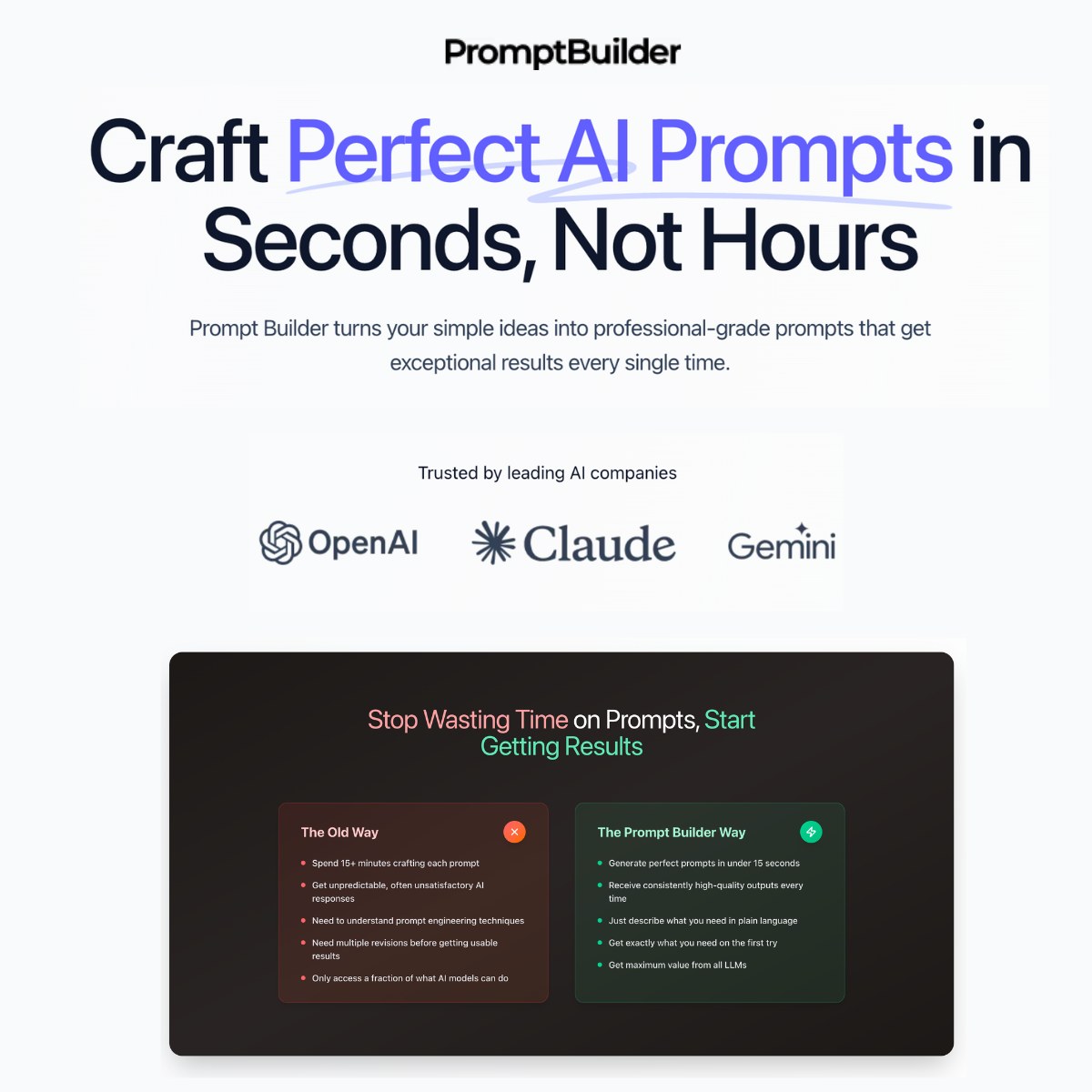
PromptBuilder
Freemium
PromptBuilder turns ideas into precise, high-quality AI prompts for ChatGPT, Claude, and Gemini. Generate, test, and organize prompts faster with structured frameworks and collaboration tools.

Prompt tools help you get better answers from AI models without rewriting the same instructions every time. This list covers AI prompt generators and optimizers that turn a rough idea into a structured prompt, prompt libraries for image models such as Midjourney and Nano Banana, tools that recover a prompt from an existing image, and prompt management platforms for teams that ship AI features. Many have a free plan or a free browser extension to start with.
PromptBuilder turns ideas into precise, high-quality AI prompts for ChatGPT, Claude, and Gemini. Generate, test, and organize prompts faster with structured frameworks and collaboration tools.

Browser extension that automatically enhances AI prompts with one click. Works across ChatGPT, Claude, and Gemini. Includes prompt library, custom variables, and local processing options.

PromptLayer is a prompt management platform for LLM teams, with a versioned prompt registry, visual editor, dataset evaluations, request logging and agent tracing across major model providers.

IV Prompt is a free, searchable library of about 800 structured AI prompts for marketing, content, business and research work, each with its use case and example.

AIPRM is a browser extension that adds a library of 5,400+ community prompt templates to ChatGPT and Claude, plus private prompts, team sharing, variables and custom profiles.
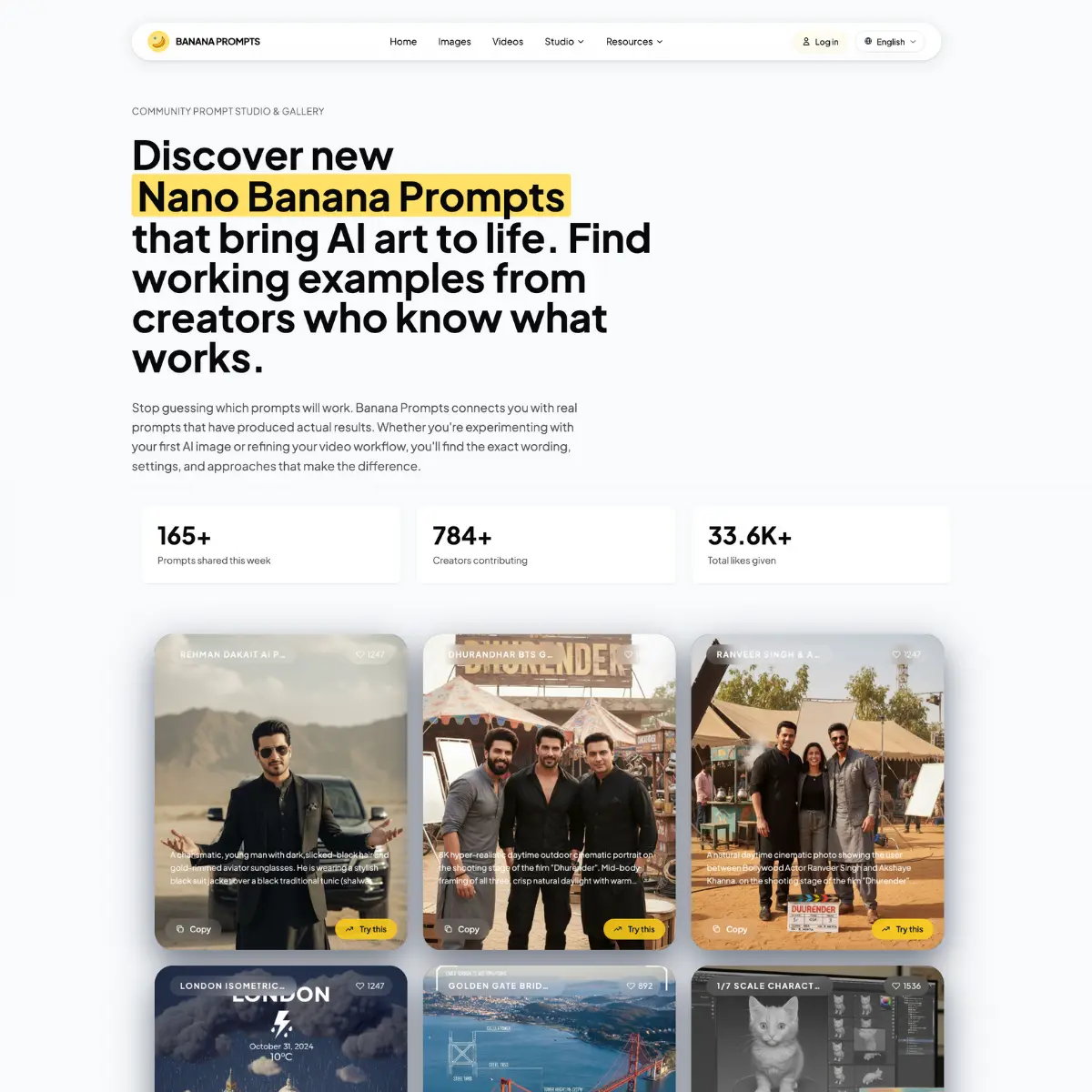
A community library of tested prompts for Google's Nano Banana and Veo models, providing real-world examples and settings for high-fidelity AI image and video generation.

LocalBanana is a prompt library and management tool for Gemini and Nano Banana models, helping users find, copy, and organize text prompts for high-quality image generation.

Reusable generative AI style prompts. Copy the prompt, swap the subject and drop it into Midjourney, Clipdrop, Firefly or DALL-E.
Most prompt tools fall into one of four groups, and the right one depends on whether you're writing prompts for yourself, borrowing ones that already work, or running prompts inside a product.
These take a short request and rewrite it with the role, context, output format and constraints a model needs. PromptBuilder builds prompts from structured frameworks for ChatGPT, Claude and Gemini, while Promptimize AI is a browser extension that improves a prompt in one click inside the chat window you already use.
Libraries save you from starting with a blank box. AIPRM adds curated prompt templates for SEO and marketing to ChatGPT. Banana Prompts and LocalBanana collect tested prompts for Google's Nano Banana and Veo models, and Freeflo offers reusable style prompts for image generators.
When you like an image and want more in the same style, IVprompt works backward from the picture to a text prompt you can paste into Midjourney, DALL-E, Flux or Sora.
Developers building on large language models need to version, test and monitor prompts the way they manage code. PromptLayer keeps a versioned prompt registry with a visual editor, evaluations against datasets and request logs across the main model providers.
It turns a rough request into a detailed prompt. A good generator adds the context, tone, format and limits you'd otherwise have to spell out, so the model's first answer is closer to what you wanted.
Many are, at least to start. Prompt libraries and browser extensions often have free tiers, while team platforms with version control and testing usually charge by usage or seat.
An optimizer rewrites a prompt you've written. A library gives you prompts other people have already written and tested, which you then adapt to your own subject.
Only if prompts run inside software you build. For everyday chat, an optimizer or a library is enough. Once several people edit prompts that customers depend on, versioning and testing stop being optional.