 TRY IT
 Ideogram
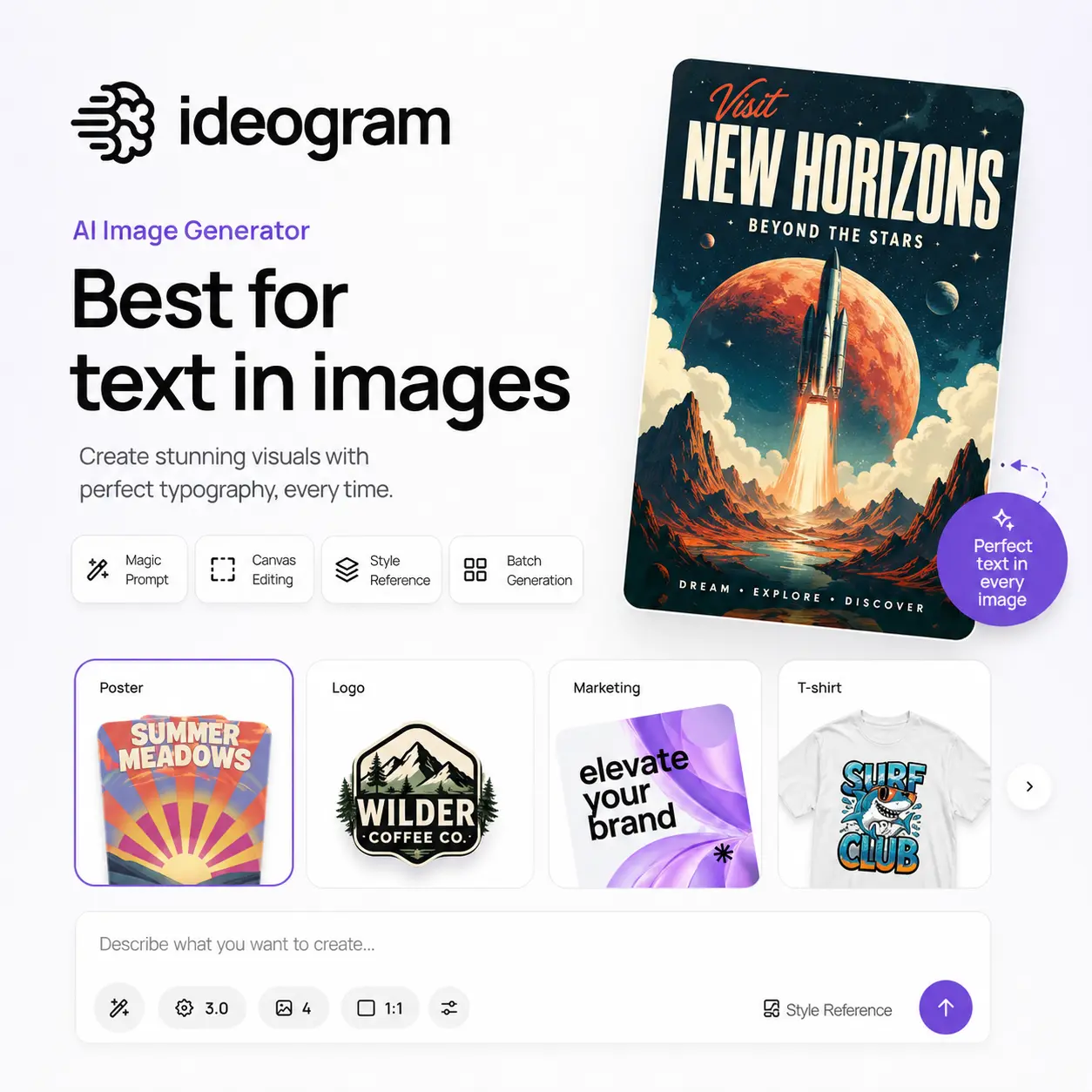
Ideogram started as a quiet challenger to the established image generators, built by former Google Brain researchers who wanted to solve a problem that everyone else had given up on: getting AI to reliably render legible text inside images. Three years and three model versions later, it has become the tool of choice for anyone who needs words to actually appear on a poster, in a logo, or across a product label.
The text rendering capability is genuinely in a different category from the competition. Ideogram 3.0, released in March 2025, scores around 90 to 95 percent accuracy on text prompts in comparative tests, meaning the word you asked for is almost always spelled correctly, positioned intentionally, and visually integrated into the design. Midjourney V7 lands closer to 30 to 40 percent on the same tests. For marketers, social media managers, and small business owners building branded content without a design budget, that gap is the whole ballgame.
Beyond text, Ideogram has built out a solid set of creative tools. Style Reference lets you upload up to three images to anchor the visual direction of your output, and Style Codes let you save and reuse a favorite aesthetic across multiple generations. Magic Prompt automatically expands sparse inputs into richer, more detailed descriptions before generation runs, which is useful when you know what you want but are not sure how to describe it in prompt syntax. The Canvas editor supports inpainting, outpainting, and extending existing images, with Magic Fill handling targeted edits within a composition.
Batch Generation (available on the Pro plan) lets you upload a CSV and run multiple variations in sequence, which is a meaningful time saver for agencies or anyone producing content at scale.
The free tier is functional, not just decorative. You get slow credits each week that produce roughly 40 images, though those images are public by default and generation speed is lower priority. Paid plans enable private generations, full resolution downloads, faster processing, and editing features. There is no editing access on the free plan.
Where Ideogram falls short is photorealism, particularly humans. Faces and hands remain inconsistent, and complex multi-person scenes can produce the usual AI artifacts familiar across this category. The upscaler has been criticized for taking liberties with source images, adjusting details like eye color or skin tone even when configured to stay close to the original. If photographic realism of people is the core requirement, other tools are a better fit.
Community sentiment is strongly positive for the specific things Ideogram does well, with many users describing it as their primary generator for anything involving text or branded design work. The complaint list is short and mostly predictable: free tier images are public, login requires Google or Apple, and the editing toolset is narrower than some alternatives.
Pros & Cons
| Pros (The Wins) | Cons (The Friction) |
| :--- | :--- |
| Text Rendering:<br>90-95% accuracy on text prompts.<br>Far ahead of any competitor. | Human Faces/Hands:<br>Inconsistent results on<br>complex figure compositions. |
| Free Tier:<br>~40 images/week at no cost.<br>Functional, not just a trial. | Public by Default:<br>Free generations are visible<br>to the whole community. |
| Style Reference:<br>Upload 3 images to lock in<br>a consistent visual style. | Upscaler Quality:<br>Can alter skin tone and<br>eye color from original. |
| Magic Prompt:<br>Expands weak prompts before<br>generation automatically. | Editing on Free:<br>Canvas, Fill, and Extend<br>require a paid plan. |