 TRY IT
 Do It Free
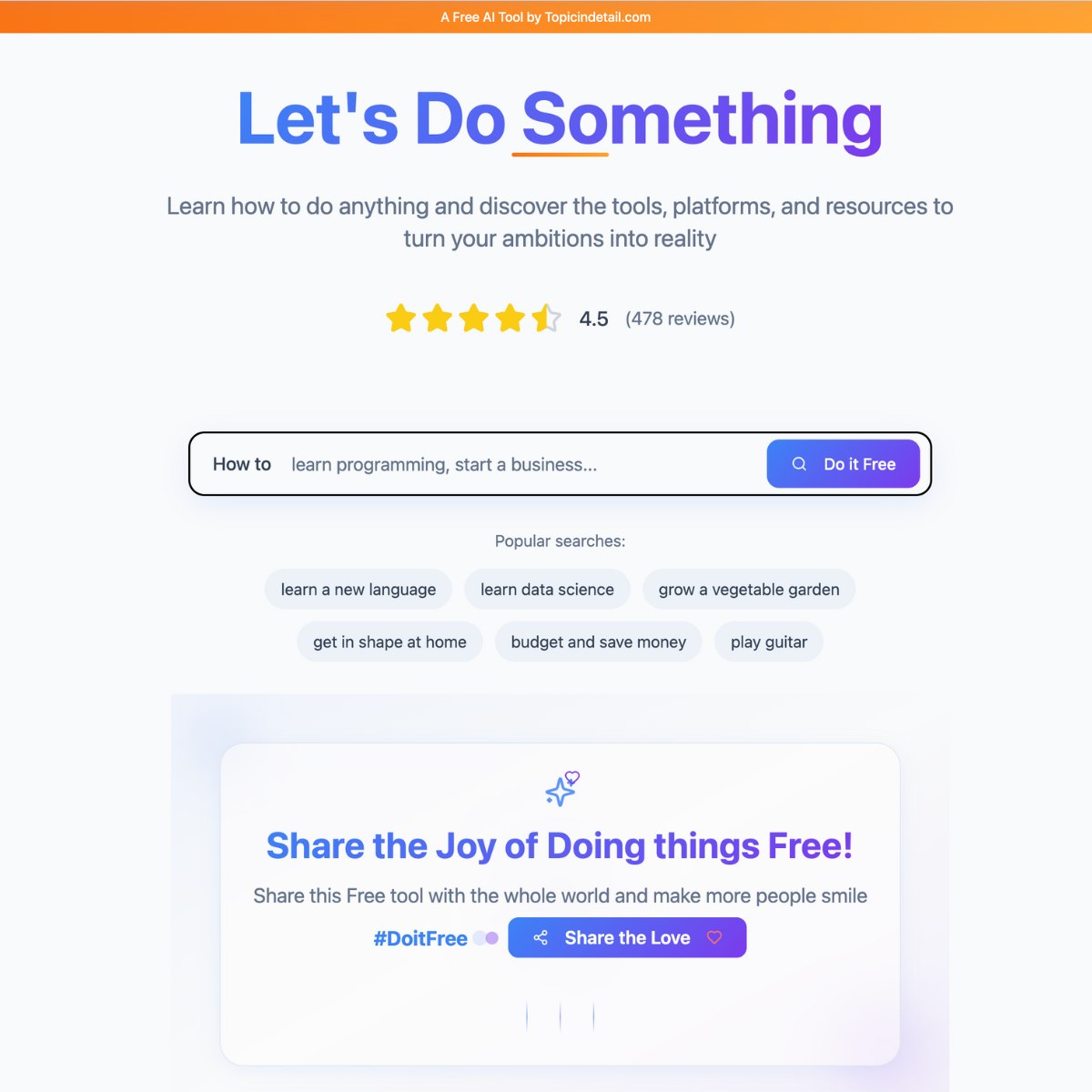
DoitFree turns “how to” searches into structured learning plans built from free, verified online resources.
Learn how to do anything and discover the tools, platforms, and resources to turn your ambitions into reality.
- learn a new language
- learn data science
- get in shape at home
- budget and save money
How it works:
In the search box, after "how to", type topics that interest you or subjects that you want to learn about.
Examples: "How to vibe code", "how to start a coffee roastery", "how to build a prompt marketplace", "how to detect ai-generated text", "how to start an ai consulting business in the United States", "how to learn prompt engineering for US tech jobs", or "how to use AI for sat or college essay prep"
Imagine typing into that blue search bar "how to vibe code", and instead of a pile of random search results, you get a fully structured roadmap like the one in the image.
Each query turns into a learning plan broken into practical phases. You get:
- Phases & Objectives: A clear progression from beginner to advanced -- for instance, "Phase 1: Understand Vibe Coding Fundamentals" gives you what to learn first, with hand-picked links to guides and tutorials.
- Resources: Verified articles, videos, and tools -- all in one place. You'll see real titles like "How to Vibe Code as a Senior Engineer" or "Complete Vibe Coding Tutorial."
- Timing & Flow: Each step estimates how long it'll take (say, "24 hours, Beginner") so you can actually plan your week.
Scroll further and it gets more social. The results expand into videos, blogs, tools/apps, platforms, and even forums where people discuss that exact topic. It's a kind of _knowledge ecosystem_ that grows from your single "how to…" prompt.
Essentially, this isn't search, it's learning by curation.
Type _"how to start a travel newsletter,"_ _"how to launch an indie SaaS,"_ or _"how to roast coffee for espresso,"_ and it assembles a free, structured syllabus with real resources you can follow immediately.
This system reframes discovery: instead of chasing scattered tutorials, it gives you a personalized map. Each "how to" is a doorway into a new world of expertise.
Here's how DoItFree can help you.
1. It turns curiosity into a learning plan
Every search begins with that simple "how to…" box. You don't need to know the jargon, just your goal.
Type _"how to build an AI chatbot for my website,"_ and the site automatically organizes the best materials into phases:
- Understand the fundamentals -- short explainers and intro videos.
- Set up your environment - the tools, libraries, or apps you'll actually use.
- Build and test - step-by-step guides and code tutorials.
- Collaborate and grow - forums and community discussions where people are doing the same thing.
You end up with a _path_, not a pile of tabs.
* * *
2. It surfaces _real_ resources, not SEO bait
Each result connects you with verified materials -- articles, GitHub repos, YouTube courses, communities -- rather than random clickbait.
For example, a search like _"how to fine-tune a local LLM"_ might show:
- An official GitHub repo explaining dataset prep.
- A tutorial video from a practitioner, not a marketer.
- A forum thread where someone solved the same problem last week.
The system curates and categorizes everything: Videos, Articles, Tools, Platforms, and Communities, just like in the image you shared.
* * *
3. It helps you _learn for free_ -- at your own pace
Each "plan" is designed with estimated times, so you can treat it like a free online course. You can decide:
- _I'll do one phase this week._
- _I'll skip to the advanced tools later._
- _I'll bookmark the community to join when I'm ready to share projects._
There's no login wall, no "buy the full course" trap. It's an open-source style experience for knowledge -- powered by public learning.
* * *
4. It's perfect for exploring new frontiers
If you're not sure what you want to learn next, use it as a discovery engine. Try typing:
- _"how to use AI in healthcare startups"_
- _"how to use ChatGPT for marketing agencies"_
- _"how to automate my side hustle with AI"_
and you'll get a roadmap that connects tools, tutorials, and discussions already happening online.
It's like having a self-assembling syllabus built by the internet itself.
* * *
5. It scales with your ambition
Beginners can use it for fundamentals ("how to understand GPTs"), while professionals can jump into niche, advanced workflows ("how to build multi-agent pipelines with n8n and OpenAI").
Because each topic connects to free, modular resources, you can keep learning indefinitely -- adding new skills whenever your goals change.
* * *
In short: DoItFree.ai is the antidote to scattered learning.
<span class="defunct">This tool appears to be unavailable or has shut down. This page is kept for reference.</span>
<h3>Alternatives to Do It Free</h3>
<ul>
<li><strong><a href="https://aitoolsdirectory.com/tool/notegpt">NoteGPT</a></strong>: Stronger for turning videos, PDFs, slides, and study materials into summaries, notes, flashcards, mind maps, and AI chat. Do It Free is better for finding a free learning path from a broad "how to" search.</li>
<li><strong><a href="https://aitoolsdirectory.com/tool/gizmo">Gizmo</a></strong>: AI study app for flashcards, quizzes, spaced repetition, and exam revision. Better for memorizing material after you already have sources; Do It Free is better for discovering what to learn first.</li>
<li><strong><a href="https://aitoolsdirectory.com/tool/consensus">Consensus</a></strong>: AI research search engine for peer reviewed papers, evidence backed answers, citations, and study snapshots. A better fit for academic research, while Do It Free is broader for practical skill building.</li>
<li><strong><a href="https://aitoolsdirectory.com/tool/gitmind">GitMind</a></strong>: Turns text, videos, audio, PDFs, websites, and spreadsheets into summaries, mind maps, diagrams, outlines, and presentations. Useful when you want to organize learning resources visually.</li>
<li><strong><a href="https://aitoolsdirectory.com/tool/ankidecks">AnkiDecks</a></strong>: Converts PDFs, slides, YouTube videos, and handwritten notes into Anki flashcards. Better for retention and review; Do It Free is better for building the initial learning roadmap.</li>
<li><strong><a href="https://aitoolsdirectory.com/tool/monic-ai">Monic AI</a></strong>: AI learning platform for quizzes, flashcards, summaries, file uploads, and personalized study support. A good Do It Free alternative for students who want active practice from their own materials.</li>
</ul>