
Claude SEO on a budget: using the DataForSEO MCP as an affordable Ahrefs alternative
24 October 2026 · Keith Lang
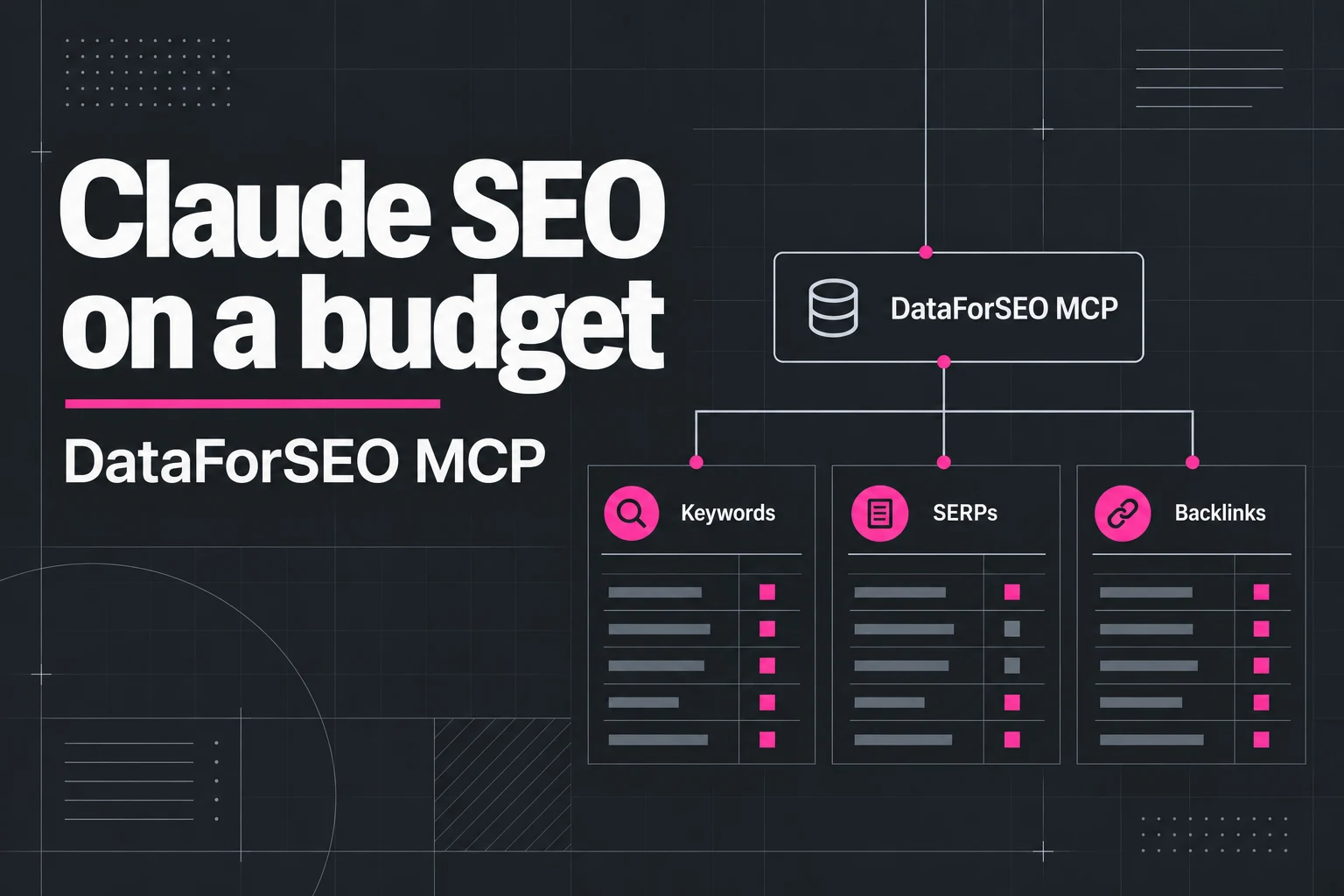
Disclosure: links to DataForSEO in this post are affiliate links. If you top up through them, AI Tools Directory earns a commission at no extra cost to you.
A lot of small site owners pay for an SEO suite every month and open it twice. A handful of keyword lookups, a quick look at what a competitor ranks for, then nothing for a fortnight.
If you already do your Claude SEO work in a chat window, there's a cheaper way to get the numbers. Ahrefs now has an MCP server that feeds its data into Claude, but it only works on paid plans from Lite upward, and every call comes out of your monthly API units. You pay the subscription first.
The DataForSEO MCP handles those data lookups with no subscription at all. You top up a balance, pay per request and let Claude do the analysis.
I connected it to Claude and ran four everyday SEO jobs against live data: keyword research, a SERP check, a competitor gap and a backlink summary. The calls covered in this post cost under 10 cents in total. All test figures below are snapshots from 24 October 2026.
How the DataForSEO MCP works
The DataForSEO MCP is a connector that lets Claude call DataForSEO's APIs in the middle of a conversation. You ask for keyword ideas or a backlink summary in plain English. Claude picks the endpoint, sends the request and reads the results back to you.
MCP stands for Model Context Protocol, the standard Claude uses to talk to outside tools. If you're new to it, my guide to MCP servers for Claude Code covers the basics. DataForSEO's server reaches its SERP, Keywords Data, DataForSEO Labs, Backlinks, On-Page, AI Optimization, Business Data and Domain Analytics APIs. It runs in Claude Desktop and Claude Code, and DataForSEO's MCP page has setup steps for Cursor, ChatGPT, Gemini CLI and Docker too.
The version I connected exposes just four tools. Three read DataForSEO's documentation. The fourth is a generic API request tool, so Claude reads the docs, works out the endpoint and builds the request itself. That's flexible, and it occasionally means Claude gets a parameter wrong and has to go back to the docs.
What you get back is raw data. There's no dashboard, no charts and no saved projects. Claude is the interface.
Can Claude do SEO without it?
Partly. Claude can write title tags, cluster a keyword list you paste in and critique a page against a brief. Without a connected SEO data source, it can't reliably report search volume or backlink counts. Claude's web search can retrieve current pages, but it doesn't replace a keyword database or backlink index. The DataForSEO MCP supplies those numbers so you can do keyword research in the same conversation.
How much does DataForSEO cost compared to Ahrefs?
DataForSEO has no subscription. New accounts get a free Sandbox that returns test data, plus $1 of trial credit for real calls. After that the minimum top up is $50, and DataForSEO says the credit doesn't expire.
These are DataForSEO charges only. Your Claude plan or model usage is separate.
What one call costs
Claude used the Live endpoints for every call in my test. That makes sense in a chat, where you want the answer now, but Live costs more than DataForSEO's queued Standard mode.
| API | Live price | What one test run cost |
|---|---|---|
| SERP | $0.002 per results page (Standard queue $0.0006) | about $0.002 |
| DataForSEO Labs (keywords, competitors) | $0.012 per task + $0.00012 per row | $0.014 for 20 keywords |
| Backlinks | $0.024 per task + $0.000036 per row | $0.024 for one domain summary |
Prices are from DataForSEO's SERP, Labs and Backlinks pricing pages. I checked the totals against my account balance before and after, and they matched after rounding to the nearest cent.
What a month looks like for a small site
Say you run one keyword research job, four SERP checks, one competitor gap and one backlink summary every week. That's about 30 calls in an average month, and at the prices above it comes to roughly 26 cents, assuming each competitor gap takes one request. Add a few cents for the odd request Claude has to retry.
At that rate the $50 minimum lasts a very long time. Heavier use changes the math fast, though: Labs and Backlinks charge per row, so pulling 1,000 keywords instead of 20 costs more like 13 cents a call.
What the Ahrefs MCP costs you
The Ahrefs MCP is included on paid plans from Lite upward. Calls through Claude count against your plan's monthly API units, and keys created through the Claude connection default to a cap of 200,000 units a month. You pay for the plan whether you make one call that month or a thousand, so check Ahrefs' pricing page for the current figure before comparing.
How to set up the DataForSEO MCP in Claude
Setup takes about five minutes. The only fiddly part is the credentials.
Get your API credentials
Create a DataForSEO account, then open the API Access page in the dashboard. Your API login and API password live there, and they're separate from the password you sign in with. The same page has a Send by Email button that emails you a Base64 token you can paste straight into Claude Code.
Claude Desktop
- Open Claude Desktop and go to Customize, then Connectors.
- Click Add custom connector and paste https://mcp.dataforseo.com/v3/mcp.
- Approve the authorization prompt that follows.
- Start a new chat. Claude asks your permission the first time it calls a DataForSEO tool.
Claude Code
The remote server is the quickest route. Swap in your Base64 token (your API login and password joined by a colon, then Base64 encoded):
claude mcp add --header "Authorization: Basic YOUR_BASE64_TOKEN" --transport http dfs-mcp https://mcp.dataforseo.com/v3/mcp
If you'd rather run it locally, you need Node.js 18 or later:
claude mcp add dataforseo \
  --env DATAFORSEO_USERNAME=your_api_login \
  --env DATAFORSEO_PASSWORD=your_api_password \
  -- npx -y dataforseo-mcp-server
Run claude mcp list afterwards to check it connected. Using Claude Code for SEO has one advantage over the desktop app: it can save results straight to files, which matters once you want history.
Other clients
Cursor, ChatGPT's developer mode, Gemini CLI and a Docker image (dataforseo/mcp) are all covered on DataForSEO's MCP page. The steps are close to the ones above.
Four prompts that replace a session in a paid SEO tool
These are the jobs most people open an SEO tool for. Each prompt below is the one I used, followed by what came back and what it cost.
1. Keyword research
Use DataForSEO to find keyword ideas for "ai seo tools" in the US. Give me the top 20 by search volume with difficulty, CPC, intent and the 12-month trend, in a table.
"ai seo tools" gets 1,900 searches a month, with a keyword difficulty of 26 and a CPC of $49.54. It's also falling: 3,600 searches in October 2025, 1,600 in September 2026. "best ai seo tools" went the other way, from 320 last November to 1,600.
One quirk. DataForSEO tagged several plain English keywords as French. The volumes were fine, but don't trust the language label.
Cost: $0.014.
2. SERP snapshot
Pull the live Google top 10 for "ai seo tools" in the US. List the ranking domains, any SERP features and the People Also Ask questions.
An AI Overview sat in position one, naming Semrush One, Ahrefs and SE Ranking as its top picks for a full SEO suite. The organic results opened with Rankability, OneLittleWeb, SEO.ai and Whatagraph. Every one of them was a vendor or a listicle.
The People Also Ask box had four questions: what AI tool is best for SEO, whether SEO can be done by AI, whether SEO is dead in 2026 and whether ChatGPT can do SEO. If you're writing on the topic, that's your FAQ section handed to you. For the content side, see my advice on ranking in AI search answers.
Cost: about $0.002.
3. Competitor gap
This one needed two attempts, and the first is worth seeing.
Find keywords theresanaiforthat.com ranks for that aitoolsdirectory.com doesn't.
Top result: "math solver", at 7.48 million searches a month. Technically correct and no use to anyone.
Same comparison, but only keywords containing "ai tool" with at least 100 searches a month, sorted by volume.
That returned 19 keywords, led by "uncensored ai tools" (5,400), "anthropic ai tool" (1,600), "unrestricted ai tools" (590) and "amazon ai tools" (480). The catch: There's An AI For That ranks between positions 30 and 85 for almost all of them. A competitor ranking on page four isn't much of a gap, so add a filter for their position too (top 20 is a sensible limit).
Claude's first attempt at the filter also used an operator the API doesn't support. The error just said the filters field was invalid, so Claude read the docs and fixed it. Expect that now and then.
Cost: about $0.028 for both runs.
4. Backlink summary
Get a backlink summary for dataforseo.com: referring domains, total backlinks, spam score, and where the links come from by TLD and country.
DataForSEO's own site shows 296,007 backlinks from 4,529 referring domains, with a domain rank of 361 and a backlink spam score of 16. That headline number shrinks once you look at the breakdown. 181,650 links come from .jetzt domains and another 84,115 from .de, so two TLDs supply about 90% of the total. 187,634 of the links are images. My guess is a small number of German sites carrying sitewide image links, but the summary alone can't confirm that.
For contrast, I ran the same prompt on overviewoptimizer.com, one of my own sites. DataForSEO first saw it on 30 April 2026, and it has 37 referring domains, 92 backlinks and a domain rank of 76. 41 of its 49 linking pages are on .com domains, mostly with the link in the page content or article body. A cluster of five from .shop is the only odd bit. Small and unremarkable, which is what six months of history looks like.
Cost: $0.024 per domain.
Getting better answers
Tell Claude the country and language up front, or it has to guess. Ask for results in a table, and ask it to name the endpoint it used so you can match each call to the usage log in your DataForSEO dashboard. Because Labs and Backlinks charge per row, set a limit on rows before Claude fetches anything. An On-Page audit of a single URL is a good fifth prompt once these four feel routine.
Where the DataForSEO MCP falls short
No history
A paid SEO suite remembers. It tracks your rankings every day and draws you a line. The DataForSEO MCP answers the question you ask right now and forgets it. If you want rank tracking, you have to schedule the checks and store the results yourself. Claude Code can write them to a file or a sheet, and DataForSEO also has an n8n integration if you'd rather build it as a workflow. My Gumloop, n8n and Make comparison covers the differences between those workflow tools.
Big responses
By default the server trims responses to the fields an AI needs. Switch that off and the output balloons: a full request for my account details came back at 443,000 characters, too big for Claude to read in one go. The trimmed mode has its own cost, though. It leaves out the price of each call, so I worked out every figure in this post from my balance. Check the usage log in your dashboard after your first session.
The learning curve
DataForSEO admits on its own comparison pages that the learning curve is steep. Claude hides most of it, but not all. Location codes and filter syntax still leak through, usually as an error Claude has to recover from.
Numbers that don't match other tools
Every SEO data provider runs its own index, and they disagree. While researching this post, Keywords Everywhere put "semrush alternative" at 1,300 US searches a month and SE Ranking put it at 40. DataForSEO's own summary for overviewoptimizer.com lists 92 backlinks but only 49 referring pages. Pick one source and stick with it when you compare month to month.
Who should use it
The DataForSEO MCP makes sense if you already spend your working day in Claude and your SEO needs come in bursts. Solo site owners and indie hackers fit that description. So do small agencies that pull a few numbers for client reports and don't want a seat license per person. For them it's an affordable SEO tool you stop paying for the moment you stop using it.
Keep your subscription if you rely on daily rank tracking, shared projects or a dashboard your client logs into. Keep it too if reading API documentation sounds like a punishment. A suite like Semrush One does all of that out of the box, and the MCP never will without some building on your part.
If you're somewhere in between, the $1 trial credit covers about 69 keyword research runs of 20 keywords each. That's enough to find out which camp you're in before spending anything.